
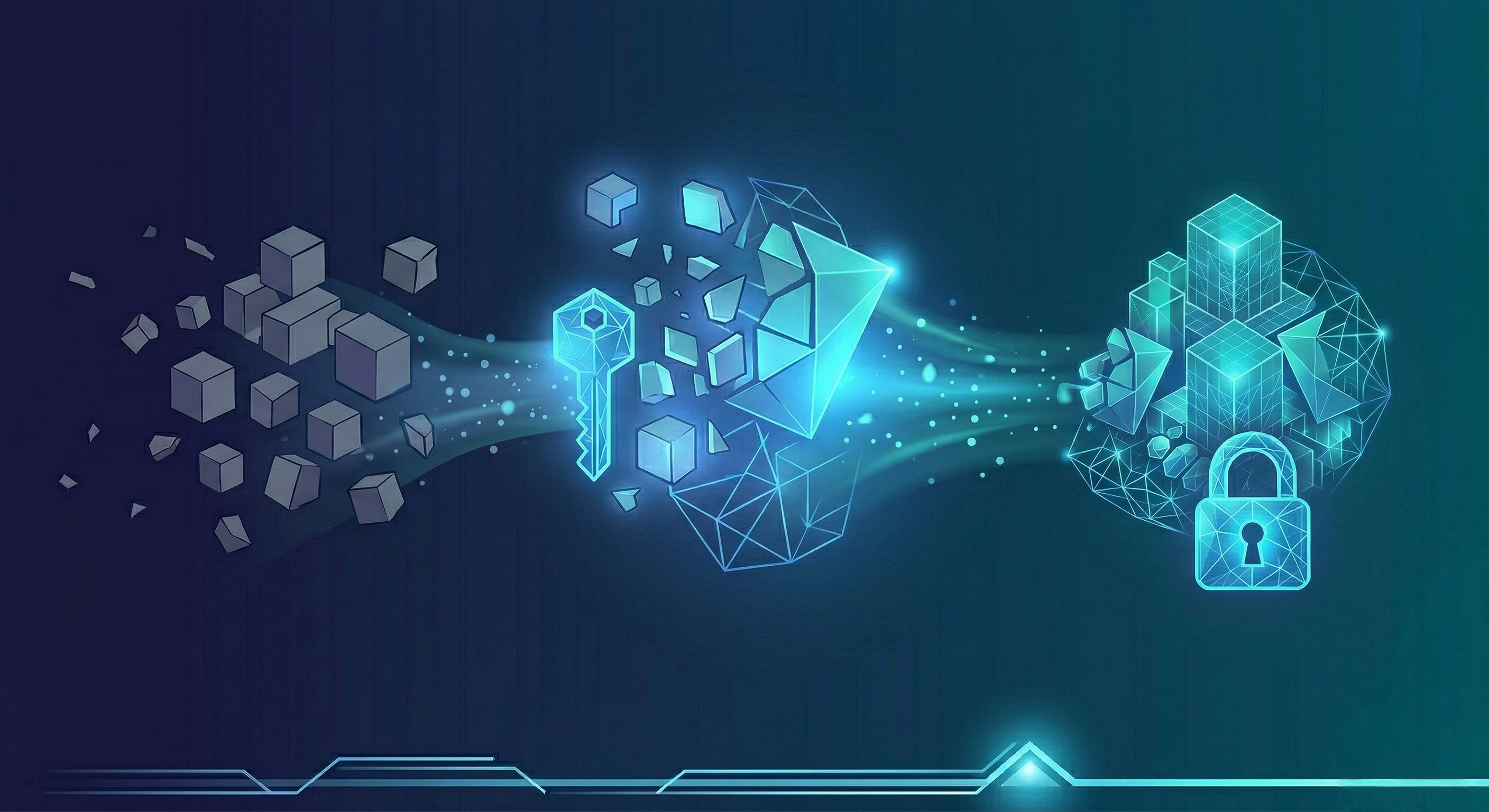
The technology industry has been quietly dreading a theoretical deadline known as "Q-Day." This is the moment a quantum computer becomes powerful enough to break the standard encryption protocols—like RSA and ECC—that currently secure the entire internet. For years, this was treated as a distant science fiction problem. However, the sudden surge of interest in Post-Quantum Cryptography (PQC) and companies like QuSecure proves that the timeline has aggressively accelerated.
Before diving into the architectural changes required to survive this shift, we need to understand the immediate threat. We are no longer waiting for Q-Day to happen before taking action, because the attacks have already begun through a method called "Store Now, Decrypt Later." Hostile entities are actively harvesting and storing massive amounts of encrypted data today. They cannot read it yet, but they are hoarding it with the expectation that a quantum computer will easily unlock it in the near future. This makes upgrading to PQC a present-day emergency for any backend developer handling sensitive information.
The Shift from Primes to Lattices
To understand the solution, we must look at how the underlying mathematics are changing. Traditional encryption relies on the extreme difficulty of factoring massive prime numbers. A classical computer would take millions of years to solve this puzzle, but a quantum computer running Shor's Algorithm can solve it in hours.
Post-Quantum Cryptography abandons prime numbers entirely. The new standard approved by the National Institute of Standards and Technology (NIST) relies heavily on something called Lattice-Based Cryptography. Instead of factoring numbers, lattice cryptography hides data within complex, multi-dimensional geometric grids. Imagine trying to find a specific intersection in a chaotic city map that exists in five hundred dimensions. Even with the advanced parallel processing capabilities of a quantum computer, calculating the correct path through these multi-dimensional grids requires an impossible amount of computational power. This is the new mathematical fortress securing our data.
The QuSecure Approach and Crypto-Agility
This mathematical shift brings a massive headache for systems engineers: how do you upgrade a massive, legacy infrastructure to use these new algorithms without breaking everything? This is exactly why QuSecure has been dominating the news cycle.
QuSecure is pioneering a concept known as "Crypto-Agility." Instead of forcing developers to manually rewrite their application code to support new cryptographic libraries, platforms like QuSecure's QuProtect operate at the network layer. They create a software-defined cryptographic tunnel. This means a developer can route their standard TLS traffic through a quantum-safe layer without having to completely re-architect their existing backend services or database connections. It provides immediate quantum resilience while buying engineering teams the time they need to upgrade their core applications organically.
The Architectural Reality for Developers
For developers focusing on clean, modern architectures, the transition to PQC introduces new physical constraints that must be accounted for in system design. Lattice-based encryption keys and digital signatures are significantly larger than traditional RSA keys.
When a client and server perform a TLS handshake using post-quantum algorithms, they are exchanging much heavier data payloads. If you are building high-performance microservices, this increase in packet size can lead to network fragmentation and increased latency during the initial connection phase. Modern backend development now requires tuning load balancers and reverse proxies to handle these larger cryptographic payloads efficiently. Furthermore, relying on modern programming languages like Rust and Go becomes critical, as their updated standard libraries are already optimized to handle the memory demands of these heavier mathematical operations without slowing down the entire system.
The Payload Challenge (MTU and Latency)
From an implementation standpoint, PQC is a "heavy" upgrade.
Classic ECC Key: ~32 bytes.
Post-Quantum (Kyber/ML-KEM) Key: ~800 to 1,200 bytes. For a backend developer, this means the initial TLS handshake is no longer a tiny exchange. It can lead to packet fragmentation if your MTU (Maximum Transmission Unit) settings aren't optimized. This is where "Crypto-Agility" tools like QuSecure become vital—they manage these heavy handshakes at the edge so your internal microservices don't choke on the increased overhead.
Why This is Fact, Not Hype:
Apple’s PQ3: In early 2024, Apple deployed PQ3 for iMessage. They didn't do it for marketing; they did it because their threat models showed that state-level actors were already hoarding encrypted messages.
Google Chrome: Chrome has already begun integrating X25519+Kyber768 hybrid key exchange for its users.
Signal: The gold standard of private messaging, Signal, upgraded to the PQXDH protocol to protect users from future quantum decryption.
Summary for your readers: We aren't moving to Post-Quantum Cryptography because quantum computers are here today. We are moving because the data we protect today must survive the technology of tomorrow.
Frequently Asked Questions
What exactly is Q-Day? Q-Day is the hypothetical date when a sufficiently stable and powerful quantum computer successfully breaks the public-key cryptography (like RSA-2048) that currently secures internet communications, banking, and military data.
If quantum computers aren't breaking encryption today, why upgrade now? The biggest risk is the "Store Now, Decrypt Later" strategy. Hackers are stealing encrypted databases and network traffic today. If your data has a long shelf life—such as financial records, health information, or national security secrets—it will be decrypted and exposed the moment a capable quantum computer comes online.
Will Post-Quantum Cryptography make my applications slower? There is a slight performance trade-off. While the actual mathematical computations in lattice-based cryptography are surprisingly fast, the size of the keys and signatures is much larger. This means the initial handshake between a server and a client takes slightly longer and consumes more network bandwidth, though the steady-state connection remains fast.
Do I need to throw away my current encryption methods? No. The current industry best practice is a "hybrid approach." Systems are currently wrapping traditional encryption (like ECC) inside a layer of post-quantum encryption. This ensures that even if a flaw is found in the new, relatively untested PQC algorithms, the classic encryption is still there as a safety net.
The Final Word
The transition to Post-Quantum Cryptography is the most significant infrastructural upgrade in the history of the internet. Companies like QuSecure are making headlines because they offer a practical, agile bridge across this dangerous gap. For developers and system architects, this is a wake-up call. Building clean, high-performance applications in 2026 requires understanding that encryption is no longer a static feature you set and forget; it is a dynamic, evolving layer of your architecture that must be prepared for the quantum era.