Beyond the reach of Mission Control, Artemis II faces its greatest engineering test. Analyzing the deterministic systems, radiation-hardened redundancy, and the orbital physics of the April 6 lunar flyby.
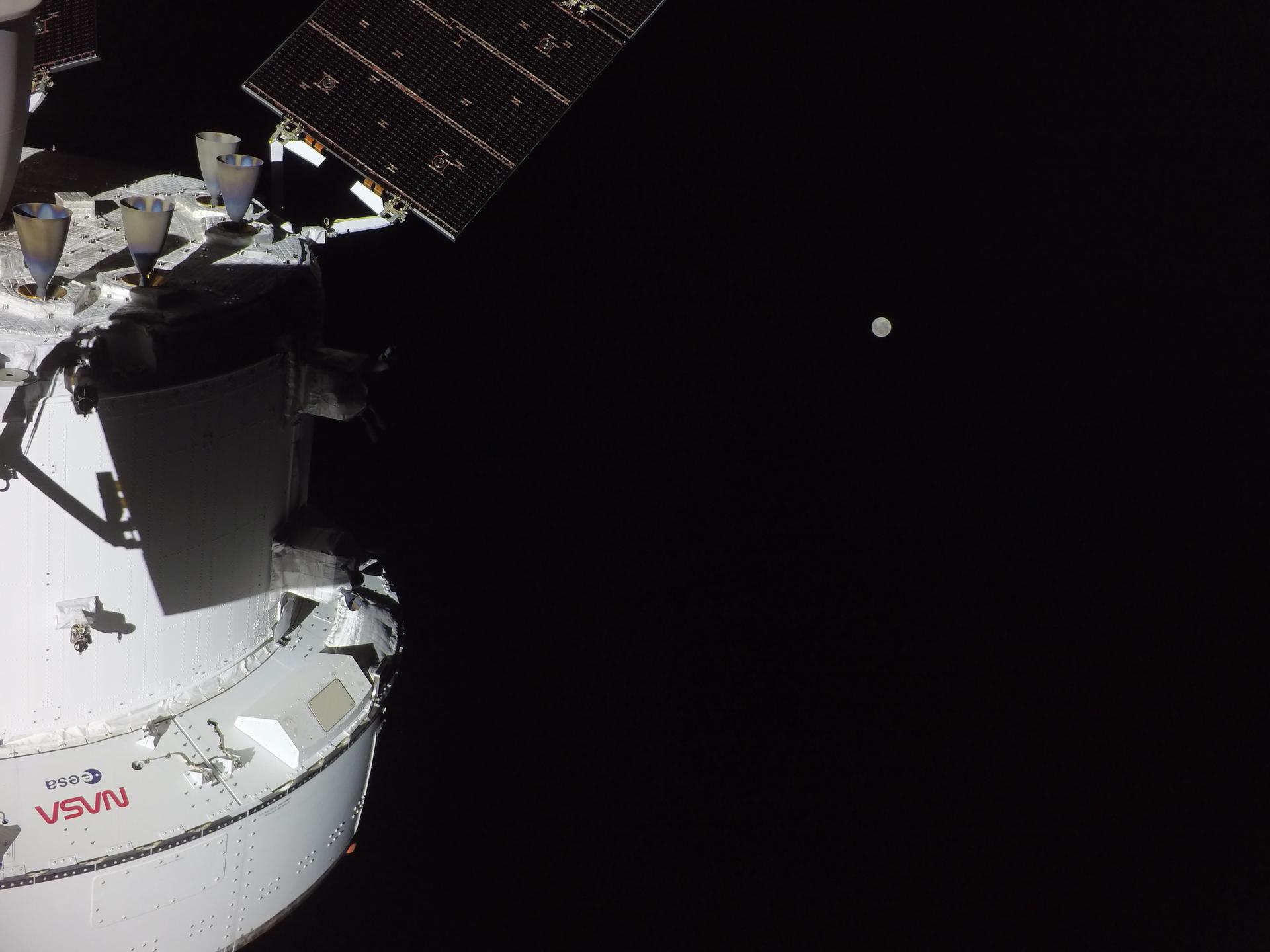
On April 1, 2026, the Space Launch System (SLS) tore through the Florida sky, initiating the Artemis II mission. Today, April 6, marks the absolute pinnacle of that 10-day journey: the lunar flyby. While the mainstream media focuses on the historic nature of the crew—Reid Wiseman, Victor Glover, Christina Koch, and Jeremy Hansen—coming within a few thousand miles of the lunar surface, the aerospace and scientific communities are focused on the extreme engineering making this exact day possible.
As Orion swings behind the far side of the Moon today to map the Orientale basin, we are witnessing the ultimate real-world stress test of autonomous fault tolerance and precision orbital mechanics.
The "Loss of Signal" (LOS) Protocol
When Orion passes behind the Moon, it enters the Loss of Signal (LOS) zone. For roughly 45 minutes, the spacecraft is completely physically shielded from Earth, severing all communication with NASA's Deep Space Network. During this window, Mission Control in Houston is entirely blind and deaf.
The survival of the crew transitions exclusively to Orion’s Vehicle Management System (VMS). The spacecraft relies on a Time-Triggered Ethernet (TTE) network. Unlike standard commercial networking where variable latency is acceptable, TTE guarantees microsecond-level, deterministic message delivery across the spacecraft's internal nodes. If a sensor detects an anomaly in the European Service Module (ESM) during this blackout, the data packet cannot be queued or delayed. The network architecture ensures critical telemetry reaches the flight computers instantly, allowing autonomous recovery scripts to execute without human intervention.
Radiation Hardening and Triple Modular Redundancy
Beyond the protective magnetic shield of Low Earth Orbit (LEO), the spacecraft is subjected to severe deep-space radiation. High-energy cosmic rays carry enough kinetic energy to strike memory registers and cause "bit-flips"—changing a 0 to a 1 in the system's memory. In a critical flight control system, a single bit-flip could result in catastrophic navigational errors.
To counter this, Orion’s flight computing system utilizes Triple Modular Redundancy (TMR) combined with self-checking architecture. The main computer consists of two modules, each containing two processors running identical code and constantly polling one another. If a radiation strike corrupts one processor, the system outvotes the corrupted node, reboots it, and resyncs the state within milliseconds. It is a masterclass in highly decoupled, fault-tolerant engineering designed to survive the harshest environment known to humanity.
The Mathematics of the Free-Return Trajectory
The beauty of today's event is rooted deeply in orbital mechanics. The Trans-Lunar Injection (TLI) burn executed days ago placed Orion on a specific "free-return" trajectory. This means that even if the Orion Main Engine (OME) suffered a complete, unrecoverable failure today, the gravitational slingshot of the Moon would naturally catch the spacecraft and hurl it back toward Earth for its planned April 10 splashdown in the Pacific Ocean.
Calculating the exact thrust required to achieve this gravitational capture relies on foundational astrophysics, specifically the Tsiolkovsky rocket equation, which dictates the maximum velocity change (Δv) based on the spacecraft's mass and exhaust velocity:
Δv=veln(m0/mf)
The precision required to execute this burn is staggering. A miscalculation of fractions of a percent during the TLI would mean the difference between a safe gravitational slingshot today and missing the return window entirely.
A Scientific Milestone
As the crew conducts targeted observations of the Moon's far side today—including potential visual data on the elusive dark-side craters—the success of April 6 proves that humanity's return to deep space is built on a foundation of unbreakable system architecture. Artemis II is not just a test of a rocket; it is a validation of the most complex, autonomous, and resilient deep-space vehicle ever engineered.
Frequently Asked Questions: Artemis II Systems Architecture
Q: Why is the Loss of Signal (LOS) window considered the most dangerous phase of the mission? A: During LOS, the Moon physically blocks all radio frequencies between Orion and Earth's Deep Space Network. This means Mission Control has zero telemetry and zero command capability. If a critical failure occurs—such as a pressure leak or a thermal control fault—the spacecraft's Vehicle Management System (VMS) must detect, diagnose, and resolve the issue entirely autonomously before communication is restored.
Q: How does Time-Triggered Ethernet (TTE) differ from standard TCP/IP networking? A: Standard commercial networks prioritize data delivery but tolerate variable latency (jitter). In spaceflight, a delayed packet can be fatal. TTE operates on a strictly deterministic schedule. Every node on the spacecraft shares a synchronized global clock, and critical telemetry (like engine valve status) is scheduled to be transmitted and received at exact microsecond intervals, guaranteeing zero collisions and absolute predictability.
Q: How does Triple Modular Redundancy (TMR) actually resolve a radiation-induced "bit-flip"? A: Orion’s main flight computer relies on multiple processors executing the exact same operations in parallel. If a high-energy cosmic ray alters the memory of one processor (causing it to output a mathematical error), its output will no longer match the others. The system uses a "voting" mechanism: it accepts the output of the majority, instantly isolates the corrupted processor, reboots it, and copies the correct state back into its memory, all without interrupting the flight software.
Q: What is the fail-safe if the Orion Main Engine (OME) refuses to fire after the lunar flyby? A: This is the primary purpose of the "free-return" trajectory. The initial Trans-Lunar Injection (TLI) burn was mathematically calculated so that the spacecraft doesn't actually need to fire its engines to return home. If the OME completely fails, the Moon's gravity will naturally alter Orion's trajectory and act as a slingshot, throwing the spacecraft back toward an Earth intercept and Pacific Ocean splashdown.
Q: What programming languages and standards govern Orion's flight software? A: The core flight software is primarily written in C++, adhering to incredibly strict coding standards (such as NASA's Power of 10 rules and MISRA C). These standards forbid dynamic memory allocation (no malloc), restrict loop bounds, and require extensive static analysis to ensure the code is mathematically provable and free of runtime memory leaks.