
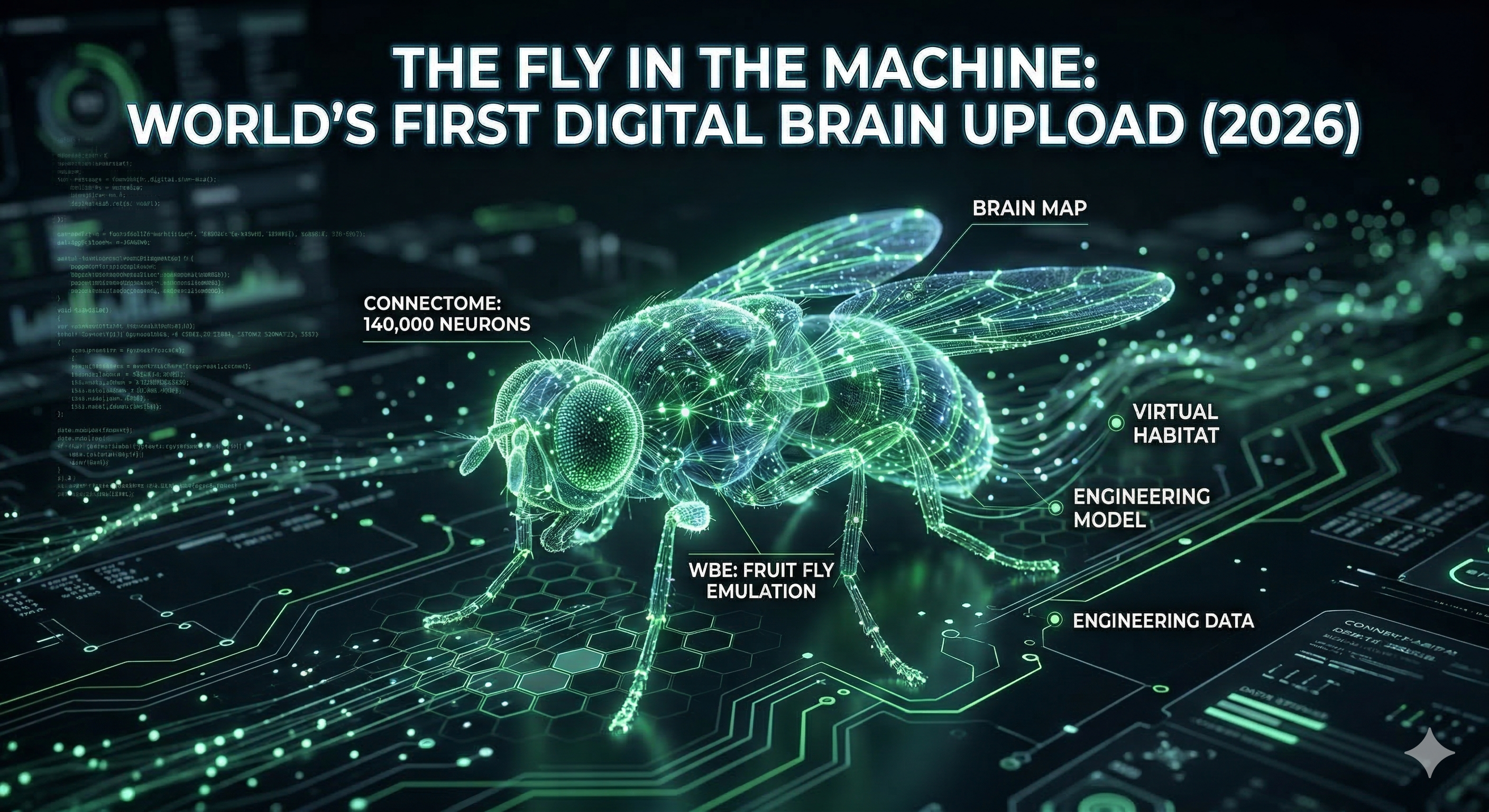
Science fiction is here. Scientists have successfully uploaded a fruit fly brain into a digital simulation, allowing it to walk and feed in a virtual world. Explore the 2026 breakthrough in whole-brain emulation.
On March 16, 2026, a San Francisco-based startup called Eon Systems achieved what was once thought to be decades away: they successfully "uploaded" the complete neural architecture of an adult fruit fly (Drosophila melanogaster) into a virtual world.
This isn't just a clever piece of code designed to mimic an insect. It is a Whole-Brain Emulation (WBE)—a digital twin of a biological brain that actually "wakes up" and behaves like a living creature. Here is the deep dive into how we reached the "Fly Matrix" and what it means for the future of humanity.
The Blueprint: Mapping the Connectome
To upload a brain, you first need a perfect map of its wiring. This map is called a Connectome.
The Scale: The researchers utilized the FlyWire dataset, which mapped all 140,000 neurons and 50 million synaptic connections of the fly at a nanometer scale.
The Precision: Every single "wire" and "switch" in the fly's head was scanned and digitized. Imagine trying to map every single electrical connection in a modern city—that is the level of complexity we are talking about.
The Simulation: Turning the "Ghost" On
Mapping is one thing; running the map is another. Eon Systems connected this digital brain to a physics-based body model called NeuroMechFly v2.
Zero Training: Unlike modern AI (like ChatGPT), which has to be "trained" on data, this digital fly was given zero instructions.
Spontaneous Behavior: As soon as the simulation was powered on, the fly began to act like a fly. It walked, it groomed its antennae, and it navigated toward virtual food sources using digital "smell" cues. With a 95% accuracy rate compared to biological flies, the simulation proved that behavior is deeply rooted in the physical structure of the brain.
Why This Changes Everything: Biology vs. Silicon
This breakthrough is the first time we’ve seen an "embodied" digital intelligence that doesn't rely on massive data centers to think.
Efficiency: A real fly runs on roughly 10 microwatts of power. By emulating this efficiency, we are discovering how to build AI that is thousands of times more energy-efficient than current GPUs.
The Path to AGI: Instead of teaching machines to mimic human language, we are learning how nature created intelligence. This could be the true shortcut to Artificial General Intelligence (AGI).
Frequently Asked Questions (FAQ)
Q: Is the digital fly actually "conscious"?
A: This is the biggest debate of 2026. While the fly responds to stimuli and behaves naturally, Eon Systems describes it as a "low-dimensional" emulation. It processes information like a fly, but whether it "feels" like a fly is something we may never truly know. As CEO Michael Andregg put it: "The ghost is no longer in the machine; the machine is becoming the ghost."
Q: Can we upload a human brain next?
A: Not yet. A fly has 140,000 neurons; a human has 86 billion. However, the success of the "Fly Matrix" provides the foundational framework. The next step is a mouse brain (roughly 70 million neurons), which Eon Systems hopes to achieve by late 2027.
Q: What are the hardware requirements to run a brain?
A: Even a fly brain requires industrial-level GPU clusters to run in real-time. However, with the arrival of integrated AI processors like NVIDIA’s Project N, we are moving toward a future where smaller neural simulations could eventually run on high-end consumer hardware.
Q: Is this the end of animal testing?
A: Possibly. One of the most practical uses for this technology is medicine. We can now test how a "digital brain" reacts to new drugs for neurological diseases without ever touching a living creature.